Introduction: Why China-Based Fulfillment Is the Backbone of Modern Shopify Brands
Here’s the reality most Shopify brand owners eventually confront: the product that generates your revenue is manufactured in China, stored temporarily in China, shipped from China — and yet your fulfillment partner is sitting in a domestic warehouse thousands of miles away, adding cost, complexity, and weeks of transit time to every single unit you sell.
It doesn’t make sense. And in 2026, more brands than ever are figuring that out.
China-based fulfillment has quietly become the operational backbone of the fastest-growing Shopify stores on the internet. Not just for scrappy dropshippers testing products on a shoestring budget, but for established direct-to-consumer brands doing 500, 2,000, even 10,000 orders a day. Brands with custom packaging. Brands with verified tracking requirements. Brands that can’t afford a 1.8% chargeback rate eating into their margins every month.
The shift isn’t theoretical. Over the last two years, a wave of Shopify merchants has moved their fulfillment operations closer to the source — consolidating sourcing, quality control, warehousing, and shipping under one roof in China. The results speak for themselves: lower per-unit costs, faster production-to-ship cycles, branded unboxing experiences that rival anything coming out of a US warehouse, and verified last-mile tracking that keeps Shopify Payments and Stripe happy.
This guide is built for Shopify brand owners who are past the “should I?” phase and firmly in the “how do I do this properly?” phase. We’ll walk through exactly what China-based fulfillment looks like in practice, how to evaluate a 3PL partner, which shipping methods actually deliver the speed and tracking quality your store needs, how to configure your Shopify backend, what mistakes will cost you money, and how Aerofulfill has engineered its entire infrastructure around making this model work at scale.
Let’s get into it.
What Is Shopify Fulfillment from China?
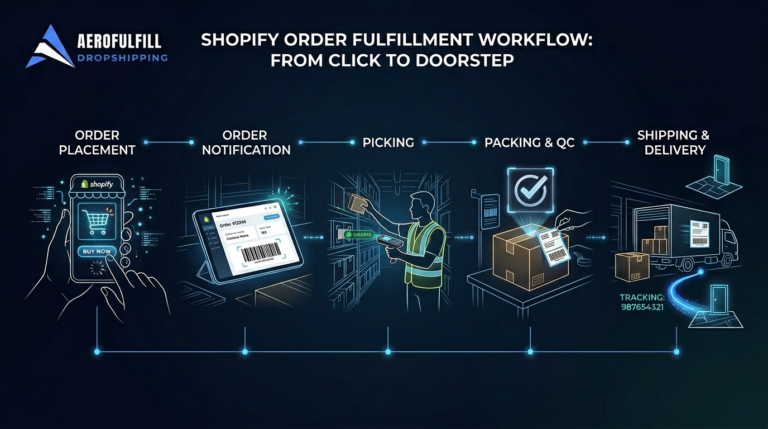
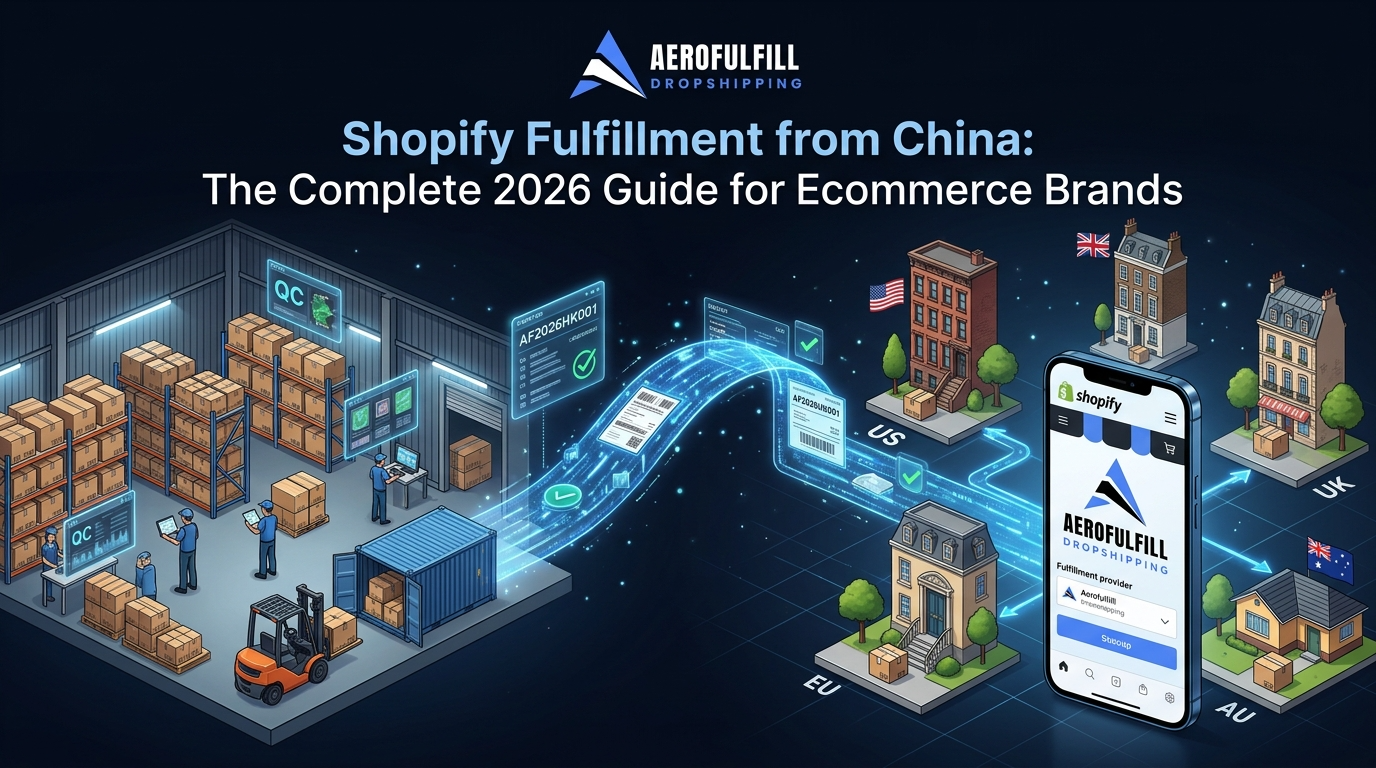
Shopify fulfillment from China is a logistics model where your products are manufactured, quality-checked, stored, and shipped directly to your global customers — all from a warehouse based in China. It eliminates the traditional step of bulk-shipping inventory to a domestic warehouse in the US, UK, or EU before individual orders go out to buyers. Instead, your fulfillment pipeline looks like this: factory produces your goods, finished inventory moves to a Chinese fulfillment center (often in the same province as the factory), orders sync from your Shopify store in real time, and each order is picked, packed, and dispatched with last-mile carrier tracking directly to your customer’s doorstep.
This model is fundamentally different from working with a domestic 3PL. When you use a US-based fulfillment provider like ShipBob, ShipMonk, or Red Stag, your products still originate in China — but you’re paying to ocean-freight or air-freight bulk inventory across the Pacific, clear customs, have it received into an American warehouse, and then fulfill orders from there. That adds 3–6 weeks of lead time before a single unit becomes “shippable.” It also ties up significant working capital in pre-positioned inventory sitting on domestic shelves. For brands still finding product-market fit or scaling aggressively with paid ads, that cash cycle can be a death sentence.
It’s also important to draw a hard line between a China-based fulfillment partner and a dropshipping supplier. These are not the same thing. A dropshipping supplier — whether it’s an AliExpress seller, a CJDropshipping agent, or a random sourcing middleman you found on WhatsApp — typically has no dedicated warehouse infrastructure, no quality control process, no contractual service-level agreements, and no native technology integration with your Shopify store. They’re a middleman adding a markup to someone else’s logistics. A legitimate China-based 3PL, on the other hand, operates its own warehouse, employs its own pick-and-pack teams, maintains ISO-certified quality control protocols, integrates directly with Shopify’s API for real-time order and inventory sync, and provides verified last-mile tracking through recognized carriers like USPS, Royal Mail, and AU Post.
The distinction matters because your fulfillment partner isn’t just moving boxes — they’re the operational backbone of your customer experience. Every late delivery, every missing tracking update, every wrong item shipped is a chargeback waiting to happen, a negative review about to be written, or a PayPal dispute that freezes your funds. The fulfillment model you choose determines whether scaling your Shopify store feels like accelerating or hitting a wall.
Benefits of Fulfilling from China
The reason so many Shopify brands are consolidating their fulfillment in China isn’t one single advantage — it’s the compound effect of several advantages working together. When your warehousing sits right next to your manufacturing, things get dramatically simpler and cheaper in ways that ripple through your entire P&L.
Lower cost of goods sold is the most immediate win. When your factory is 40 minutes from your fulfillment center instead of 8,000 miles away, you eliminate international freight costs on the front end. There’s no ocean container to fill, no customs brokerage for a bulk import, no domestic trucking from port to warehouse. Your finished goods move from factory floor to fulfillment shelf for a fraction of what it costs to reposition that same inventory in a US warehouse. For most brands, this alone represents a 15–25% reduction in landed cost per unit.
Proximity to manufacturing changes how quickly you can react. When a product is selling faster than expected, your fulfillment partner can coordinate a replenishment run with the factory in days, not weeks. There’s no six-week ocean transit window standing between your production line and your shippable inventory. This proximity also unlocks something most domestic 3PLs simply cannot offer: the ability to make product modifications, packaging changes, or quality corrections in real time. Your Logistics Architect can walk into the factory, flag an issue, and have it resolved before the next production batch enters the warehouse.
Consolidated sourcing and fulfillment under one partner eliminates the fragmentation that plagues most Shopify supply chains. Instead of managing a sourcing agent, a freight forwarder, a customs broker, and a domestic 3PL as four separate relationships with four separate failure points, a full-service China-based fulfillment partner handles the entire chain. Product sourcing, supplier negotiation, OEM/ODM coordination, quality inspection, warehousing, order fulfillment, and global shipping — one partner, one dashboard, one point of accountability.
Faster production-to-ship cycles mean your cash isn’t trapped in inventory sitting on a boat. In the traditional model, you place a production order, wait for manufacturing, wait for ocean freight, wait for customs clearance, wait for domestic receiving — and only then can you start selling those units. That cycle can be 8–12 weeks. With China-based fulfillment, finished goods go from factory to warehouse shelf in 1–3 days, and the first customer orders can ship the same week production completes. The impact on cash flow is enormous, especially for brands running aggressive paid acquisition campaigns where every day of capital lockup reduces your ability to reinvest.
Branded packaging capabilities are often the surprise advantage. Chinese fulfillment centers with in-house packaging infrastructure can offer custom boxes, poly mailers, tissue paper, branded tape, thank-you cards, promotional inserts, and lookbook materials at costs that are significantly lower than equivalent services from a US-based 3PL. Your customers get a premium unboxing experience. Your margins stay healthy. And the branded touchpoint drives the repeat purchase behavior and organic social content (think TikTok unboxing videos) that compounds your marketing investment over time.
How to Choose a China-Based 3PL for Shopify
Not all China-based fulfillment providers are created equal, and choosing the wrong one can cost you far more than the few dollars per order you thought you were saving. The 3PL you select becomes the physical extension of your brand — they’re touching every product, packing every box, and delivering (or failing to deliver) the experience your customers expect. Here’s how to evaluate them properly.
Shopify integration capability should be your first filter. You need a partner with a native API connection to Shopify — not one that requires you to export CSV files, use third-party middleware, or manually copy-paste order details into a separate system. A proper integration means orders flow from your Shopify store to the fulfillment center in real time, tracking numbers upload automatically to each order, inventory levels sync bidirectionally so your store never oversells, and fulfillment status updates push to your customers without you lifting a finger. If a 3PL tells you their “integration” involves a Google Sheet or a daily batch file, walk away. That workflow breaks the moment you start doing serious volume, and it introduces human error into every single order.
Warehouse certifications and operational standards tell you whether the facility is actually built for ecommerce fulfillment or whether it’s a converted storage unit with some shelving. Look for ISO certification, which indicates standardized quality management processes that don’t degrade under pressure. Ask about their picking methodology — are they using barcode-verified scanning at every stage, or relying on visual verification where a warehouse worker eyeballs the label? At 100 orders a day, visual picking might hold up. At 1,000 orders a day, a 4% error rate means 40 wrong packages going out every single day. Each one is a refund, a return, a chargeback, or a lost customer.
Tracking quality is the single biggest differentiator between a professional China-based 3PL and a cheap dropshipping agent. This is where most brands get burned. A lot of fulfillment providers from China generate tracking numbers that look valid in their system but never actually scan at the destination carrier. The customer sees “tracking number provided” in their Shopify notification, clicks the link, and gets nothing — no scan events, no estimated delivery, just a dead page. That customer files a chargeback. Shopify Payments flags your store. Your funds get frozen. The fix is verified last-mile carrier injection, which means the package is physically inducted into the destination country’s postal network (USPS in the US, Royal Mail in the UK, AU Post in Australia) and generates real, trackable scan events from that carrier. Platforms like 17Track should show continuous scan updates from origin to delivery. If a 3PL can’t demonstrate this with real examples, they’re not ready to handle your brand’s reputation.
Communication responsiveness is non-negotiable when you’re working across time zones. You need a dedicated account manager — not a shared support queue where your urgent question sits behind 200 other tickets. The best China-based 3PLs assign a named contact (at Aerofulfill, this role is called a Logistics Architect) with a guaranteed response SLA. When something goes wrong at 2 AM your time, you need to know that someone is already aware and working on it, not that you’ll need to send a follow-up email in 12 hours.
Quality control processes should be documented and consistent. Ask specifically what happens when inventory arrives at the warehouse from your factory. Is every unit inspected? Is there a sampling protocol? What happens when a defective item is found — is it quarantined, photographed, and reported to you, or does it just get shipped to a customer who then leaves a one-star review? Inbound QC is your last line of defense before a product reaches a paying customer, and your 3PL should treat it with the seriousness it deserves.
Scalability is the factor most brands underweight during their evaluation — and the one that bites them the hardest six months later. Your ads start performing, a product goes viral on TikTok, or Black Friday hits and your order volume triples overnight. A 3PL that was perfectly adequate at 200 orders a day suddenly can’t keep up at 800. They miss dispatch SLAs, start batching shipments instead of same-day processing, and your customers are left waiting. Before signing with any partner, understand their facility capacity, their surge protocol, and whether their operational model is headcount-based (which means slow, linear scaling) or infrastructure-based (which means they can absorb volume spikes without hiring and training new staff over two weeks).
Shipping Methods and Transit Times
The shipping method your China-based 3PL uses directly impacts your customer experience, your chargeback rate, your ad profitability, and your Shopify store’s long-term health. Choosing the right logistics channel is about finding the intersection of speed, tracking reliability, and cost that makes sense for your product and your customer’s expectations. Here’s what’s actually available in 2026 and how each option performs.
ePacket was once the default shipping method for anyone selling from China to the US, thanks to a postal treaty that kept costs artificially low. In 2026, ePacket is still functional but significantly less competitive than it was. Transit times to the US now sit at 15–25 business days in most cases, tracking is inconsistent after the package leaves China (it often goes dark for 7–10 days during transit), and weight restrictions limit you to packages under 2kg. For Shopify brands selling anything beyond the lowest-price impulse-buy products, ePacket’s slow delivery and weak tracking create a customer experience problem that erodes lifetime value and inflates chargebacks. It still has a place for ultra-budget, low-AOV products where customers have low delivery expectations, but serious brands have moved on.
Yanwen operates as a mid-tier logistics provider with a large network across Europe and North America. Transit times typically run 10–18 business days to the US and UK, with slightly longer windows to Australia and Canada. Tracking quality is moderate — you’ll get scan events at origin and usually at destination, but the in-transit period can be opaque. Yanwen is a reasonable option for brands shipping lightweight products where 2-week delivery is acceptable, but it doesn’t offer the speed or tracking granularity that Shopify’s payment processors increasingly expect for chargeback protection.
YunExpress has become one of the most popular dedicated-line carriers for Shopify sellers shipping from China. They offer 7–12 business day delivery to the US, 7–15 days to the UK and EU, and 8–15 days to Australia. Their Delivered Duty Paid (DDP) service for Europe is particularly valuable, as it means your EU customers don’t get hit with unexpected customs charges on delivery — a common reason for refused packages and chargebacks. Tracking quality is solid, with scan events at origin, in-transit checkpoints, and handoff to local carriers for last-mile delivery. YunExpress occupies a good middle ground between cost and performance for brands that aren’t yet ready for premium shipping speeds but need better tracking than ePacket or Yanwen can provide.
4PX is a Shenzhen-based logistics company backed by Cainiao (Alibaba’s logistics arm) with a global network covering over 200 countries. They offer multiple service tiers, with standard delivery to the US in 7–15 business days and express options that bring that down to 5–8 days. 4PX provides end-to-end tracking and has strong infrastructure in the US, UK, and EU for last-mile handoff. Their direct line services are particularly competitive for lightweight parcels under 2kg heading to North America and Western Europe.
DHL eCommerce (not to be confused with DHL Express, which is significantly faster and more expensive) offers a reliable middle-to-premium option with transit times of 5–10 business days to the US and 5–8 days to major EU markets. Tracking quality is excellent — DHL’s network provides granular scan events throughout the journey, and the DHL brand name on the tracking page gives customers confidence that their package is in a legitimate logistics pipeline. For brands with average order values above $30–40 where customer expectations skew toward faster delivery, DHL eCommerce hits a strong balance of speed, tracking quality, and cost.
Dedicated line shipping (sometimes called “special line” or “contract logistics”) is the premium tier that the best China-based 3PLs offer. This is where your fulfillment partner has negotiated direct contracts with airlines and last-mile carriers to create a proprietary shipping channel that bypasses the general postal network. Packages are consolidated at the China warehouse, air-freighted on contracted flights, cleared through customs in the destination country, and injected directly into the local carrier network (USPS, Royal Mail, AU Post, Canada Post, DHL, Colissimo) for last-mile delivery. Transit times for dedicated lines typically run 5–7 business days to the US, UK, and Australia, with 6–8 days for EU markets and 7–10 days for Canada. Tracking is fully verified from origin to delivery, with court-admissible delivery confirmation. This is the method used by fulfillment partners like Aerofulfill that offer contractual SLA-backed delivery windows with automatic credits if transit times are missed.
For quick reference, here’s how transit times typically break down by destination for the most common methods:
United States: ePacket 15–25 days, Yanwen 10–18 days, YunExpress 7–12 days, 4PX 7–15 days, DHL eCommerce 5–10 days, Dedicated Line 5–7 days.
United Kingdom: ePacket 15–25 days, Yanwen 10–18 days, YunExpress 7–15 days, 4PX 8–15 days, DHL eCommerce 5–8 days, Dedicated Line 5–7 days.
European Union (DE/FR): ePacket 15–30 days, Yanwen 12–20 days, YunExpress 8–15 days, 4PX 8–15 days, DHL eCommerce 5–10 days, Dedicated Line 6–8 days.
Australia: ePacket 15–30 days, Yanwen 12–20 days, YunExpress 8–15 days, 4PX 10–18 days, DHL eCommerce 7–12 days, Dedicated Line 5–7 days.
Canada: ePacket 15–25 days, Yanwen 12–20 days, YunExpress 10–15 days, 4PX 10–18 days, DHL eCommerce 7–12 days, Dedicated Line 7–10 days.
The pattern is clear: as you move from economy postal services to dedicated-line shipping, transit times compress, tracking reliability improves, and chargeback exposure drops. For most Shopify brands doing meaningful volume, the additional per-unit cost of a dedicated line pays for itself through reduced chargebacks, faster fund releases, better customer reviews, and higher repeat purchase rates.
Setting Up Your Shopify Store for China Fulfillment
Getting your Shopify store properly configured for China-based fulfillment isn’t complicated, but it does need to be done right. Gaps in this setup create operational headaches that multiply with every order — wrong products shipped, tracking that doesn’t sync, inventory that shows available when it’s actually out of stock, and customers who never receive a shipping notification. Here’s the step-by-step process.
Connect your fulfillment partner’s integration. If your 3PL offers a native Shopify API connection (which is the minimum you should accept), this typically involves authorizing the integration through your Shopify admin panel. For providers like Aerofulfill, the connection is established via Shopify’s REST and Webhook APIs — no third-party app installation required. Your Logistics Architect or onboarding contact should handle the technical configuration, but the authorization step requires you as the store owner to grant API access. Once connected, your Shopify store becomes a live data feed: new orders trigger real-time webhooks to the fulfillment center, and tracking numbers, fulfillment statuses, and inventory counts flow back automatically.
Map your SKUs correctly. This is the step that trips up more brands than anything else. Every product variant in your Shopify store — every size, color, material, bundle configuration — needs to map to a unique SKU in your fulfillment partner’s warehouse management system. If your Shopify store lists “Black / Medium” as a variant with SKU “BLK-M-001,” your 3PL’s system needs to recognize that exact string and associate it with the correct bin location in the warehouse. Mismatched SKU mapping is the number one cause of wrong-item shipments, and it’s entirely preventable with a careful one-time setup. Go through your full product catalog with your fulfillment partner before a single order ships.
Configure order routing rules. If you’re using multiple fulfillment locations (for example, a China warehouse for most products and a US warehouse for a specific product line), you need to set up order routing logic in Shopify. This can be done through Shopify’s native multi-location inventory settings, where you assign each product to its fulfillment location. When an order comes in containing products from different locations, Shopify can split the order and route each item to the correct warehouse. If all your products ship from China, this is simpler — you just set your China fulfillment location as the default and ensure all SKUs are assigned there.
Enable real-time inventory sync. Your fulfillment partner’s system should push inventory updates back to Shopify whenever stock levels change — whether that’s because an order was shipped, a return was processed, or new inventory was received from your factory. This bidirectional sync prevents overselling, which is one of the fastest ways to generate chargebacks and angry customers. Verify that the sync is truly real-time (updated within minutes of a change) rather than batch-processed on a schedule. A 3PL that only updates inventory once or twice a day leaves you exposed to overselling during high-traffic periods when stock moves fast.
Set up tracking number integration. When your fulfillment partner dispatches an order, the tracking number should automatically upload to the corresponding Shopify order, trigger the customer notification email, and update the order status to “fulfilled.” This should happen without any manual intervention from you. Test this with a few sample orders before going live to confirm that tracking numbers are populating correctly, that the tracking links resolve to the correct carrier page (USPS, Royal Mail, etc.), and that the notification emails look right. A broken tracking email — one with a dead link or a tracking number that shows no data — does more damage to customer trust than no email at all.
Configure your shipping zones and rates. In your Shopify admin under Settings → Shipping and Delivery, create shipping zones that match the markets your China fulfillment partner covers. For each zone, set shipping rates that reflect what you want to charge customers (free shipping, flat rate, or calculated rates) and shipping speed descriptions that align with your 3PL’s actual transit times. If your fulfillment partner delivers to the US in 5–7 business days, don’t list “Standard Shipping (3–5 days)” on your checkout page. Mismatched expectations between what you promise and what you deliver are a direct pipeline to chargebacks and negative reviews. Be honest, and if your shipping times are competitive (which 5–7 days from China absolutely is), let that speed sell itself.
Run test orders before going live. Place 3–5 test orders to different destinations and track them through the entire pipeline: order sync to warehouse, pick and pack, tracking upload to Shopify, customer notification, carrier scan events, and final delivery. Open the packages when they arrive. Check that the right product was picked, the packaging matches your brand standards, inserts and thank-you cards are included, and the tracking history shows a clean chain of scan events. This test run costs you the price of a few products and shipping charges. Skipping it can cost you your first hundred customers.
Common Mistakes to Avoid
After working with thousands of Shopify brands making the transition to China-based fulfillment, certain mistakes show up again and again. They’re all avoidable, but only if you know to watch for them.
Choosing the cheapest 3PL you can find is the most expensive mistake in the long run. When a fulfillment provider is significantly undercutting everyone else on price, there’s a reason — and it’s usually because they’re cutting corners on tracking quality, quality control, packaging materials, or warehouse staffing levels. You might save $0.30 per order on pick-and-pack fees, but when your chargeback rate jumps from 0.5% to 2% because tracking numbers aren’t scanning at destination carriers, you’re losing dollars for every cent you saved. Evaluate total cost of fulfillment, which includes the fulfillment fee plus chargebacks, frozen funds, return costs, customer service hours spent on “where’s my order” tickets, and the lifetime value of customers you lose to a poor delivery experience.
Ignoring tracking quality until chargebacks start piling up is the second most common mistake. Many brands don’t realize their tracking is weak until Shopify Payments or Stripe starts holding funds, or until PayPal dispute rates trigger an account review. By that point, you’re in a reactive firefight trying to switch providers while your revenue is frozen. Before committing to any 3PL, ask them to show you five live tracking numbers from recent shipments to your target markets. Plug those numbers into 17Track and the destination carrier’s website. If you see full scan history from pickup through delivery with a carrier you recognize (USPS, Royal Mail, AU Post), the tracking infrastructure is real. If you see a tracking number that was “created” but shows no scan events for 10+ days, that’s a manufactured number — and it will destroy your store’s payment processing standing.
Not testing with sample orders before committing your full volume is remarkably common, and remarkably foolish. You wouldn’t launch a product without a prototype, and you shouldn’t launch a fulfillment partnership without test orders. Ship at least 3–5 orders to different countries before routing all your production volume to a new partner. Track every step. Open every package. Evaluate the experience as your customer would. If the test orders reveal problems — wrong items, damaged packaging, dead tracking links, excessive transit times — you’ve identified those issues at a cost of $50–100 instead of discovering them after 500 customers have had the same experience.
Skipping quality control or assuming your factory ships perfect product every time is a gamble that will eventually lose. Even the best factories have off days, off batches, and off workers. Without an inbound QC process at your fulfillment warehouse — where every shipment from the factory is inspected, sampled, or fully checked before entering saleable inventory — defective products will reach your customers. A customer who receives a stained garment, a broken component, or a mislabeled product doesn’t just return the item. They leave a public review, they file a chargeback, and they never buy from you again. Your 3PL should have a documented QC protocol that includes visual inspection, sampling rates, defect quarantine procedures, and photo documentation that’s shared with you.
Underestimating customs duties and import regulations catches brands off guard, especially when shipping to the EU, UK, and Australia where duty thresholds and VAT collection rules have changed significantly in recent years. If your customers are being asked to pay unexpected customs charges on delivery, many of them will refuse the package — which means you’ve paid for shipping, lost the sale, and now have a product sitting at a foreign postal warehouse with no easy way to retrieve it. Work with your fulfillment partner to understand the customs treatment of your products in every target market. Where possible, use Delivered Duty Paid (DDP) shipping services that pre-clear customs and include duties in the shipping cost, so your customer receives their package with no surprise charges. This is especially important for the EU, where the elimination of the VAT exemption on low-value imports means virtually every package from China now requires VAT payment.
How Aerofulfill Handles Shopify Fulfillment
Aerofulfill was built from the ground up around a single premise: Shopify brands that source from China shouldn’t have to stitch together five different vendors and three different dashboards to get products to their customers. The entire infrastructure — from warehouse operations to technology integration to account management — was designed specifically for the Shopify fulfillment model.
The cornerstone of how Aerofulfill operates is the Logistics Architect model. Every brand that onboards is assigned a named, dedicated account manager called a Logistics Architect. This isn’t a shared support representative who handles 300 accounts and takes 48 hours to respond to a ticket. Your Logistics Architect is your single point of contact for everything: onboarding configuration, SKU mapping, packaging design, QC protocols, shipping route optimization, carrier selection, surge planning, and weekly performance reviews. They carry a 1-hour escalation SLA, which means when something needs attention, it gets attention — not a promise to “circle back tomorrow.” During high-volume periods like Black Friday or a product going viral, the review cadence shifts from weekly to daily. They’re monitoring your pipeline and catching problems before they reach your inbox.
Operationally, Aerofulfill runs out of an 80,000 square foot warehouse in Wuxi, Jiangsu province — one of China’s primary manufacturing and logistics corridors. This isn’t a shared warehouse with 500 other sellers crammed into a rented space. It’s a purpose-built fulfillment facility with dedicated zones for receiving, storage, pick-and-pack, quality control, and carrier staging. The facility handles 10,000+ orders per day at peak capacity, with a surge protocol that activates additional pick-pack stations and QC lines within 72 hours of detecting elevated order velocity. No advance notice required. No renegotiation of terms. The infrastructure scales with your growth, not against it.
The Shopify API integration is native — meaning it connects directly to Shopify’s REST and Webhook APIs without any third-party apps, middleware, or manual data handling in between. When a customer places an order on your store, a real-time webhook fires to Aerofulfill’s fulfillment engine. The order is verified, the SKU is validated against the warehouse management system, a pick ticket is generated, and the item enters the same-day dispatch queue. All orders received before 6 PM CST are picked, packed, quality-checked, and dispatched the same day. Once dispatched, the tracking number, fulfillment status, and customer notification push back to Shopify automatically. Inventory levels sync bidirectionally in real time, so your store never oversells and your stock counts are always accurate across every sales channel.
Branded packaging is included in the fulfillment workflow with no setup fees. Custom boxes, poly mailers, tissue paper, branded tape, thank-you cards, promotional inserts, and lookbook materials are all assembled per your brand’s specifications during the packing stage. Each product or product category can have a different packaging profile, and your Logistics Architect manages the design coordination and production timeline. Most brands are packaging-ready within two weeks of onboarding. The result is a premium unboxing experience that drives repeat purchases and generates the kind of organic social content — TikTok unboxings, Instagram stories — that no amount of ad spend can buy.
The piece that ties everything together is verified last-mile tracking through carrier injection. Every package Aerofulfill dispatches is physically inducted into the destination country’s carrier network: USPS for the United States, Royal Mail for the United Kingdom, AU Post for Australia, Canada Post for Canada, DHL and Deutsche Post for Germany, Colissimo for France. This means your customer’s tracking page shows real scan events from a carrier they recognize and trust. More importantly, it generates court-admissible delivery documentation — the kind of evidence that Shopify Payments and Stripe need to resolve disputes in your favor and release your funds within 48 hours instead of holding them for weeks. Aerofulfill’s average chargeback rate across 5 million+ fulfilled orders sits at 0.04%, compared to the industry average of 1.8%. For a brand doing 1,000 orders a day at a $35 average order value, that difference represents roughly $18,000 a month in recovered revenue.
Delivery is SLA-backed: 5–7 working days to the US, UK, and Australia, 6–8 days to Germany and France, and 7–10 days to Canada. These aren’t aspirational targets — they’re contractual commitments. If the SLA is missed, automatic shipping credits are applied to your account without you needing to file a claim or argue with a support agent.
Onboarding is designed to get your store live within 24 hours for standard setups, or 3–7 days for complex integrations. During the transition from a previous fulfillment provider, Aerofulfill runs parallel fulfillment — your old partner keeps shipping while Aerofulfill ramps up, ensuring zero orders go unfulfilled and zero downtime for your store. The entire migration is managed by your Logistics Architect, from API connection and SKU mapping to test orders and go-live.
Conclusion: Your Fulfillment Should Be as Strong as Your Product
If you’re reading this, you probably already know that fulfillment is the part of your Shopify business that either compounds your growth or quietly kills it. The product can be perfect. The ads can be dialed. The landing page can convert like crazy. But if the package shows up late, or the tracking goes dark, or the wrong item is in the box — none of that upstream work matters. The customer doesn’t see your ad spend or your conversion rate. They see what arrives at their door and how long it took to get there.
China-based fulfillment in 2026 is not the wild west it was five years ago. The infrastructure exists. The shipping speed exists. The tracking quality exists. The branded packaging capability exists. What separates a fulfillment operation that scales your brand from one that drags it down is the partner you choose and how thoughtfully you set it up.
Aerofulfill was built specifically for Shopify brands that source from China and sell globally — with the warehouse infrastructure, technology integration, verified tracking, and dedicated account management to make that model work at 50 orders a day or 10,000. If you’re currently losing revenue to chargebacks, slow delivery, frozen funds, or a fulfillment partner that can’t keep up with your ad spend, it might be time to see what the numbers look like with a partner that was engineered for exactly this.
Get a free, custom fulfillment quote within 24 hours. Per-unit pricing, shipping rate matrix, projected savings vs. your current provider, and a 1-on-1 strategy call with a dedicated Logistics Architect. No commitment. No pressure. Just numbers.
Related Resources
Shopify Fulfillment Solutions — Full breakdown of Aerofulfill’s Shopify fulfillment infrastructure, SLA guarantees, and onboarding process.
Product Sourcing Solutions — OEM/ODM manufacturing, private labeling, supplier management, and quality inspection — all managed by your Logistics Architect.
Branded Packaging — Custom boxes, mailers, tissue paper, inserts, and thank-you cards. No setup fees. Premium unboxing that drives repeat purchases.
Need Help With Your Fulfillment or Sourcing?
Get a custom quote — free, no commitment, within 24 hours. Trusted by 5,000+ Shopify brands.