Every Shopify Order Follows a Lifecycle — And Every Stage Has a Leak
There’s a version of your Shopify business that runs like a machine. An order comes in, payment clears, the warehouse picks and packs the product, a carrier scans it, the customer gets notified at every step, and a branded package arrives at their door five days later. No chargebacks. No “where’s my order?” tickets. No frozen funds.
Then there’s the reality most Shopify brands actually live in: tracking numbers that go dark for a week, payment processors holding funds because delivery can’t be verified, returns sitting in limbo, and a customer experience that degrades at exactly the moment it should be building trust.
The difference between those two scenarios isn’t luck — it’s workflow. Specifically, it’s whether you understand the seven stages every Shopify order passes through, where the friction points are at each stage, and what your fulfillment infrastructure is actually doing (or failing to do) at every handoff.
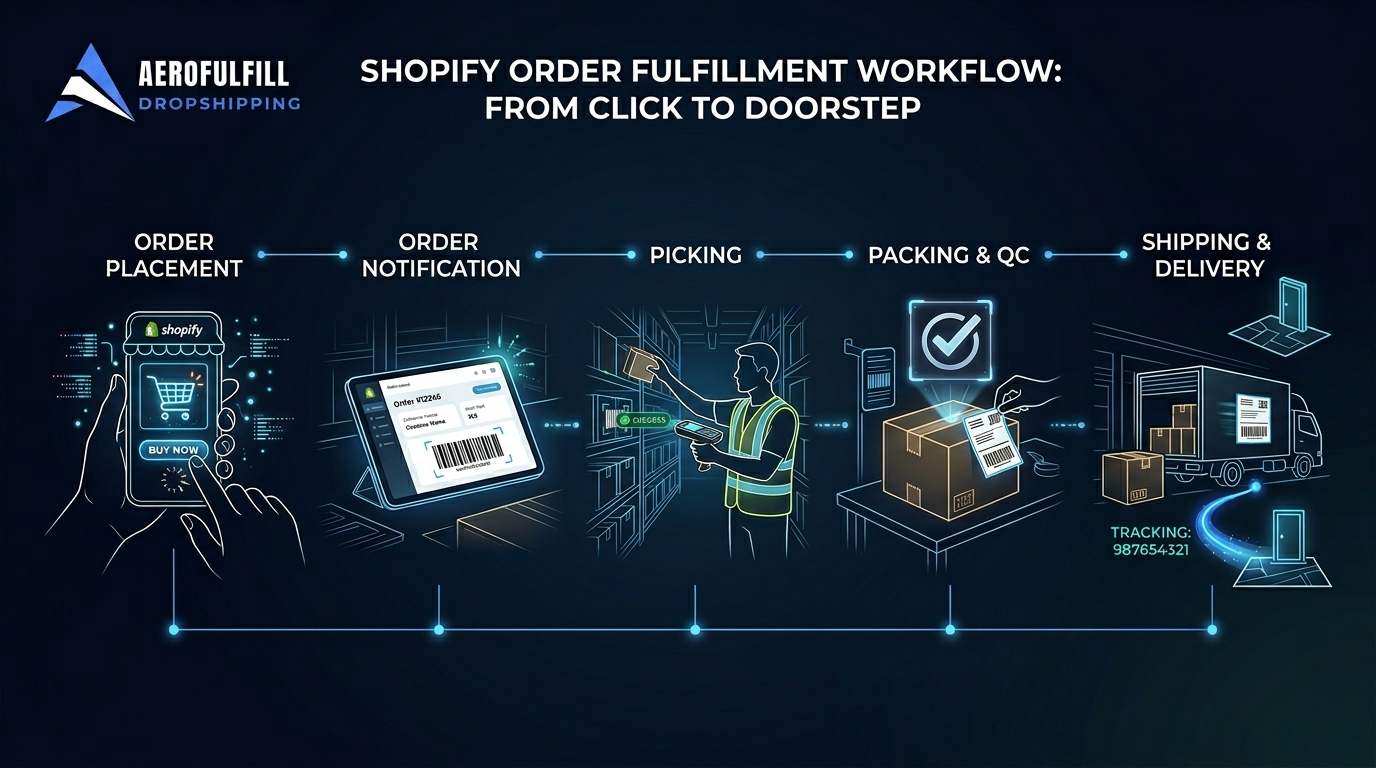
This guide walks through the entire Shopify order fulfillment workflow from the moment a customer clicks “Buy Now” to the moment the package hits their doorstep — and what happens after. Whether you’re fulfilling from a domestic warehouse, working with a China-based 3PL, or evaluating whether your current setup is costing you more than it should, the framework is the same. The execution is where brands separate themselves.
Step 1 — Order Placement and Payment Capture
The fulfillment lifecycle starts before your warehouse ever touches a product. It starts at checkout.
When a customer completes their purchase on your Shopify store, two things happen almost simultaneously. The order is created in your Shopify admin with all the line item details — products, variants, quantities, shipping address, and customer information. At the same time, the payment gateway processes the transaction. If you’re using Shopify Payments (which runs on Stripe’s infrastructure), the customer’s card is authorized and, depending on your settings, funds are either captured automatically or held for manual capture.
Most Shopify stores run automatic payment capture, which means the charge is finalized the moment the order is placed. This is the simplest setup and works well for brands with low fraud exposure. But if you’re running high-volume paid traffic — especially broad-targeting Facebook or TikTok campaigns that attract a mixed audience — automatic capture means you’re charging every card that comes through, including fraudulent ones. By the time you realize the order was placed with a stolen card, you’ve already shipped the product and the chargeback is incoming.
This is where Shopify’s built-in fraud analysis becomes relevant. Shopify uses machine learning algorithms to flag orders as low, medium, or high risk based on signals like AVS (Address Verification System) mismatches, IP address geolocation inconsistencies, multiple failed payment attempts, and whether the billing and shipping addresses are in different countries. The fraud indicators show up directly on the order page in your Shopify admin.
The operational decision here is straightforward but important: if you’re running manual payment capture, you have a window (typically 7 days before the authorization expires) to review flagged orders before charging the customer. If you’re running automatic capture, you need a downstream system — like Shopify Flow — that can automatically cancel or hold high-risk orders before they enter your fulfillment queue. Shipping a flagged order without review is how brands end up in Shopify Payments’ fraud monitoring program, which can lead to increased reserve requirements or outright termination of your payment processing.
The key takeaway at this stage: payment capture and fraud screening aren’t “payment team problems.” They’re fulfillment problems. A fraudulent order that enters your pick-and-pack queue costs you the product, the shipping, and the chargeback fee. Getting this step right is the first defense in your entire fulfillment workflow.
Step 2 — Order Transmission to Fulfillment Center
Once an order is confirmed and payment is captured, it needs to reach your fulfillment center. How this happens determines how fast and how accurately your warehouse can act on it.
In a properly integrated setup, Shopify fires a real-time webhook — essentially an instant data push — the moment a new order is created. That webhook contains the full order payload: order ID, line items with SKU codes, quantities, shipping address, shipping method selected, and any special instructions. Your fulfillment partner’s system receives this webhook, validates the data against its warehouse management system, confirms that the requested SKUs are in stock and in their correct bin locations, and generates a pick ticket that enters the dispatch queue.
This entire sequence — from customer click to pick ticket generated — should take less than five minutes with a native API integration. No human intervention. No manual order entry. No CSV export-import cycle.
The reality is that a lot of Shopify brands aren’t operating at this level. Many fulfillment providers, particularly smaller agents and sourcing middlemen, don’t have native Shopify API integrations. Instead, they rely on workarounds: the brand exports orders from Shopify as a CSV file, emails it to the fulfillment team, someone manually enters the orders into the warehouse system, and processing begins hours (sometimes a full business day) later. Every step in that chain introduces delay and error. A typo in manual data entry means a wrong product ships. A missed email means orders sit unprocessed for a day. At 50 orders a day, this is annoying. At 500 orders a day, it’s operationally catastrophic.
The other piece that matters here is order queue management — how your fulfillment center prioritizes and batches incoming orders. The best operations sort orders by carrier type and destination zone to optimize batch picking and shipping manifests. Orders heading to the same country via the same carrier can be processed together, which reduces per-unit handling time and creates cleaner carrier handoffs. If your 3PL is processing orders in the random sequence they arrive without any queue logic, you’re leaving efficiency on the table at every dispatch cycle.
When evaluating a fulfillment partner, ask specifically how orders are transmitted. If the answer involves spreadsheets, email, or a third-party middleware app that requires your attention to stay running, you’re looking at a bottleneck that will break under load.
Step 3 — Pick and Pack
This is the physical heart of fulfillment — where a digital order becomes a tangible package. It’s also where the widest variance in quality exists between fulfillment providers.
Picking is the process of retrieving the correct items from their storage locations in the warehouse. In a barcode-verified picking system, the warehouse worker scans the bin location barcode first, then scans the item barcode. The warehouse management system confirms the match before allowing the item to proceed to the packing station. If there’s a mismatch — wrong SKU, wrong variant, wrong size or color — the system blocks the pick and alerts the worker. This dual-scan verification is how professional fulfillment operations maintain accuracy rates above 99.5%, even at high volume. It’s a non-negotiable for any brand with more than a handful of SKUs or products with multiple variants.
The alternative — visual picking, where a worker reads a pick list and grabs what they think is the right item — works at small scale but degrades predictably as order volume grows. At a 96% visual picking accuracy rate (which is actually considered decent for manual operations), a brand doing 2,000 orders a day is shipping 80 wrong items every day. Each one is a customer service ticket, a return shipment, a replacement order, and potentially a chargeback. The cost of those 80 daily errors almost always exceeds the cost of implementing barcode-verified picking.
Packing is where your brand identity either gets delivered or gets lost. A generic poly mailer with a product tossed inside tells your customer that you’re a commodity. Custom branded packaging — a branded box or mailer, tissue paper wrapping, a printed thank-you card, a promotional insert, a branded sticker sealing the package — tells them they bought from a brand that cares about the details. The unboxing experience directly influences whether a customer posts about your product on social media, whether they remember your brand name two months later, and whether they come back for a second purchase.
The QC checkpoint that happens between picking and packing is the final quality gate before a product reaches a customer. At this stage, the item should be visually inspected for defects, damage, or incorrect labeling. For apparel, this means checking for stains, loose threads, and correct size tags. For electronics, it means verifying the unit powers on or that all components are present. For consumables, it means confirming expiration dates and packaging integrity. Whatever your product category, this inspection should be documented — ideally with photo evidence for each batch — so that when a customer claims they received a defective item, you have records to reference.
The brands that treat pick-and-pack as a cost center to minimize end up paying far more on the back end in returns, chargebacks, and lost customers than they ever saved on warehouse labor.
Step 4 — Shipping Label Generation and Carrier Handoff
Once a package is sealed and QC-cleared, it needs a shipping label, and it needs to be handed to the right carrier at the right time.
Carrier selection should be systematic, not arbitrary. Your fulfillment partner should route each package to the optimal carrier based on the destination country, package weight and dimensions, your cost tier with that carrier, and the transit time SLA you’ve committed to on your Shopify store. A package heading to the US from a China fulfillment center might route through USPS via a dedicated line, while the same product going to Germany routes through DHL or Deutsche Post, and an Australian order goes through AU Post. This routing logic should be automated within the warehouse management system — not decided by a warehouse worker making a judgment call at the shipping station.
Label generation happens at this stage. The system creates a shipping label with the destination address, carrier barcode, package weight, and the tracking number that will follow this package through its entire journey. The tracking number is simultaneously written back to the Shopify order (more on this in the next step) and added to the carrier’s manifest — the master list of all packages being tendered to that carrier in the current batch.
Manifest creation is the operational handshake between the warehouse and the carrier. A well-managed fulfillment center creates manifests at fixed cutoff times (for example, 6 PM local time), bundles all packages for each carrier, and tenders them at a scheduled pickup or drop-off. This is the “first-mile” — the movement of packages from the warehouse to the carrier’s sortation network. In China-based fulfillment, first-mile logistics typically involve the packages moving from the warehouse to a consolidation hub where they’re grouped by destination country, loaded onto air freight (either contracted flights for dedicated-line carriers or general cargo for economy services), and flown to the destination region.
The quality of this handoff — how cleanly packages transfer from warehouse to carrier, how quickly the carrier generates their first scan event, and how reliably the manifest data matches the physical packages — directly determines whether your tracking looks professional or amateur to the end customer. A carrier that doesn’t generate an acceptance scan for 48–72 hours after the package leaves your warehouse creates a dead zone in your tracking timeline that makes customers nervous and makes payment processors suspicious.
Step 5 — In-Transit Tracking and Customer Notifications
This is the stage where customer perception is formed, and where weak fulfillment infrastructure causes the most visible damage to your brand.
The moment a shipping label is generated and the tracking number is assigned, that number should sync back to the corresponding Shopify order automatically through the API integration. Shopify then triggers the “shipping confirmation” notification to your customer — an email (and SMS, if configured) containing the tracking number and a link to track the package. This notification is often the single most-opened email in the entire customer journey, with open rates that dwarf any marketing campaign. It’s a high-attention touchpoint, which means the tracking experience it leads to had better be good.
What “good” looks like: the customer clicks the tracking link and sees their package moving through a recognizable logistics pipeline. Picked up in the origin country. Departed from origin. Arrived at destination country. Cleared customs. Handed to local carrier (USPS, Royal Mail, AU Post). Out for delivery. Delivered. Each scan event is timestamped, and the customer can see continuous progress without multi-day gaps where nothing updates.
What “bad” looks like — and what happens with a shocking number of China-based fulfillment operations — is the customer clicks the link and sees either nothing at all (the tracking number was generated but the carrier hasn’t acknowledged the package) or a single “shipment information received” event followed by days of silence. The customer doesn’t know if their product was actually shipped, if it’s in transit, or if it’s sitting in a warehouse. They contact your support team. If support can’t provide clarity (because the fulfillment partner’s tracking is genuinely opaque), the customer disputes the charge. That dispute becomes a chargeback. Enough chargebacks and your payment processor starts holding your revenue.
The technical difference that separates these two experiences is carrier injection versus carrier notification. Carrier injection means the package is physically inducted into the destination carrier’s network — it’s scanned by USPS, Royal Mail, or AU Post, and it appears in their system as an active package with real scan events. Carrier notification means the fulfillment provider sent the carrier a data file saying “this package exists,” but the package hasn’t been physically scanned yet. The tracking number is technically valid, but it shows no movement until the package physically arrives and gets scanned at the destination facility, which could be days or weeks later.
For Shopify brands, this distinction isn’t academic — it’s the difference between a 0.04% chargeback rate and a 1.8% chargeback rate. It’s the difference between Shopify Payments releasing your funds in 48 hours and holding them for 21 days. If your fulfillment partner can’t demonstrate verified carrier injection with continuous scan events from origin to delivery, your tracking quality is a liability, not an asset.
Third-party tracking platforms like 17Track aggregate scan events across multiple carriers and give both merchants and customers a single interface to follow a package’s journey. If your fulfillment partner’s tracking numbers resolve cleanly on 17Track with full scan history from a recognized last-mile carrier, your tracking infrastructure is solid. If 17Track shows a tracking number with no updates for 10+ days, you have a problem that needs to be addressed before it manifests as frozen revenue.
Step 6 — Last-Mile Delivery
Last-mile delivery is the final leg of the journey — the movement of the package from the local carrier’s distribution facility to the customer’s address. It’s also the stage most Shopify merchants have the least visibility into and the most anxiety about.
In a well-designed fulfillment workflow, the package has already been injected into the destination country’s carrier network by this point. USPS has it in their system in the US. Royal Mail is processing it in the UK. AU Post is routing it in Australia. The local carrier handles sortation to the regional distribution center, route assignment to a delivery driver, and the delivery attempt itself.
Delivery attempt management varies by carrier and country. Most carriers will make one or two delivery attempts before holding the package at a local post office or distribution center for customer pickup. Some carriers offer redelivery scheduling or safe-place delivery authorization. The customer’s experience with this final step — whether the driver found their apartment easily, whether the package was left in a secure location, whether they were notified of a missed attempt — is outside your direct control as the merchant, but it’s entirely within the scope of the carrier relationship your fulfillment partner has established.
Proof of delivery is the critical output of this stage. When a carrier scans a package as delivered, that event is timestamped and geolocated. For Shopify brands, this delivery confirmation serves two purposes. First, it closes the loop on the customer experience — the customer sees “Delivered” in their tracking, and the order lifecycle is complete. Second, and more importantly for your business operations, it creates verifiable evidence that the product was delivered. When a customer files a chargeback claiming they never received their order, the delivery confirmation is the evidence Shopify Payments and Stripe use to resolve the dispute in your favor. Without court-admissible delivery proof — which requires the delivery to be logged by a recognized carrier, not just by a third-party logistics middleman — you have no defense against delivery disputes, and you absorb the chargeback plus the fee every single time.
This is precisely why carrier injection matters so much. A package that was “delivered” according to an unrecognized logistics provider’s internal system doesn’t carry the same evidentiary weight as a delivery confirmed by USPS, Royal Mail, or AU Post. Payment processors know the difference. Dispute arbitration systems know the difference. And your chargeback rate reflects the difference.
Step 7 — Post-Delivery — Returns and Customer Feedback
The order has been delivered, but the fulfillment workflow doesn’t end at the doorstep. What happens after delivery determines whether that customer becomes a repeat buyer or a one-time transaction that left a sour taste.
Returns are an operational reality for every Shopify brand. Industry-wide, ecommerce return rates sit between 15–30% depending on the product category, with fashion and apparel at the high end. How your fulfillment partner handles returns directly impacts whether returned inventory goes back into saleable stock or disappears into a black hole. A proper returns workflow looks like this: the customer initiates a return through your Shopify store or a returns management app, receives a return shipping label or instructions, sends the product back, the fulfillment center receives the return, inspects the item for damage and completeness, processes it back into sellable inventory if it passes inspection (or quarantines it if it doesn’t), and updates your Shopify inventory in real time. The turnaround from return receipt to inventory restock should be 48 hours or less. Any longer and you’re losing sales on products that are physically in your warehouse but not available to sell.
For brands fulfilling from China, returns require a slightly different approach since it’s often impractical for customers to ship items back across the Pacific. Many China-based 3PLs handle this by partnering with domestic return addresses in key markets (a US address for American returns, a UK address for British returns) or by issuing refunds without requiring the physical product back for low-value items where the return shipping cost would exceed the product’s value. The right approach depends on your product’s value, your margin structure, and your return rate. Your fulfillment partner should have a clear, documented returns protocol for each of your target markets.
Refund processing on the Shopify side is straightforward — you issue a full or partial refund through the order page, and Shopify Payments processes the refund back to the customer’s original payment method. The operational nuance is timing: refunding quickly improves customer satisfaction and reduces the likelihood that the customer escalates to a chargeback. A customer who waits two weeks for a refund is far more likely to file a dispute than one who sees the credit back on their card within 48 hours.
The often-overlooked final piece of the fulfillment workflow is using delivery and post-delivery data to improve your operations. Every order that completes the full cycle — from checkout to delivery — generates data points that should inform your decisions. Which shipping routes are consistently meeting their SLA and which are running late? Which products have the highest return rates, and is the root cause a quality issue, a sizing issue, or a listing accuracy issue? Which carrier generates the most “item not received” claims in which markets? Are chargebacks concentrated around specific products, traffic sources, or delivery destinations?
This data exists in your Shopify admin, your fulfillment partner’s dashboard, and your payment processor’s reports. Brands that review it weekly and use it to make operational adjustments — rerouting problem shipping lanes, fixing product listings that generate returns, tightening QC on high-defect SKUs — see their fulfillment metrics improve compounding over time. Brands that never look at it repeat the same expensive mistakes on every order.
Your Fulfillment Workflow Is Your Customer Experience
Every step in this seven-stage workflow is a moment where your brand either builds trust or breaks it. Payment capture protects you from fraud. Order transmission speed determines how quickly your customer’s purchase becomes a real shipment. Pick-and-pack accuracy decides whether they get the right product in the right packaging. Carrier selection and handoff determines whether the tracking page tells a coherent story or goes dark for a week. Last-mile delivery creates the proof that protects your revenue from chargebacks. And your post-delivery operations determine whether a single purchase becomes a long-term customer relationship.
At Aerofulfill, every one of these stages is engineered into a single, integrated pipeline. Native Shopify API integration with real-time webhooks. Barcode-verified picking with ISO-certified QC. Branded packaging assembled to your specifications. Verified last-mile carrier injection through USPS, Royal Mail, and AU Post. Contractual 5–7 day delivery SLAs with automatic credits. Court-admissible delivery documentation that drops chargeback rates to 0.04%. And a dedicated Logistics Architect who monitors every stage of your workflow and acts before problems reach your inbox.
If your current fulfillment workflow has holes in it — slow order transmission, weak tracking, packaging that doesn’t represent your brand, or a chargeback rate that’s eating your margins — you don’t need to overhaul everything at once. You need a partner that’s already built the workflow you need.
Related Resources
Shopify Fulfillment · Solutionschargeback Prevention · Solutionsbranded Packaging
Need Help With Your Fulfillment or Sourcing?
Get a custom quote — free, no commitment, within 24 hours. Trusted by 5,000+ Shopify brands.