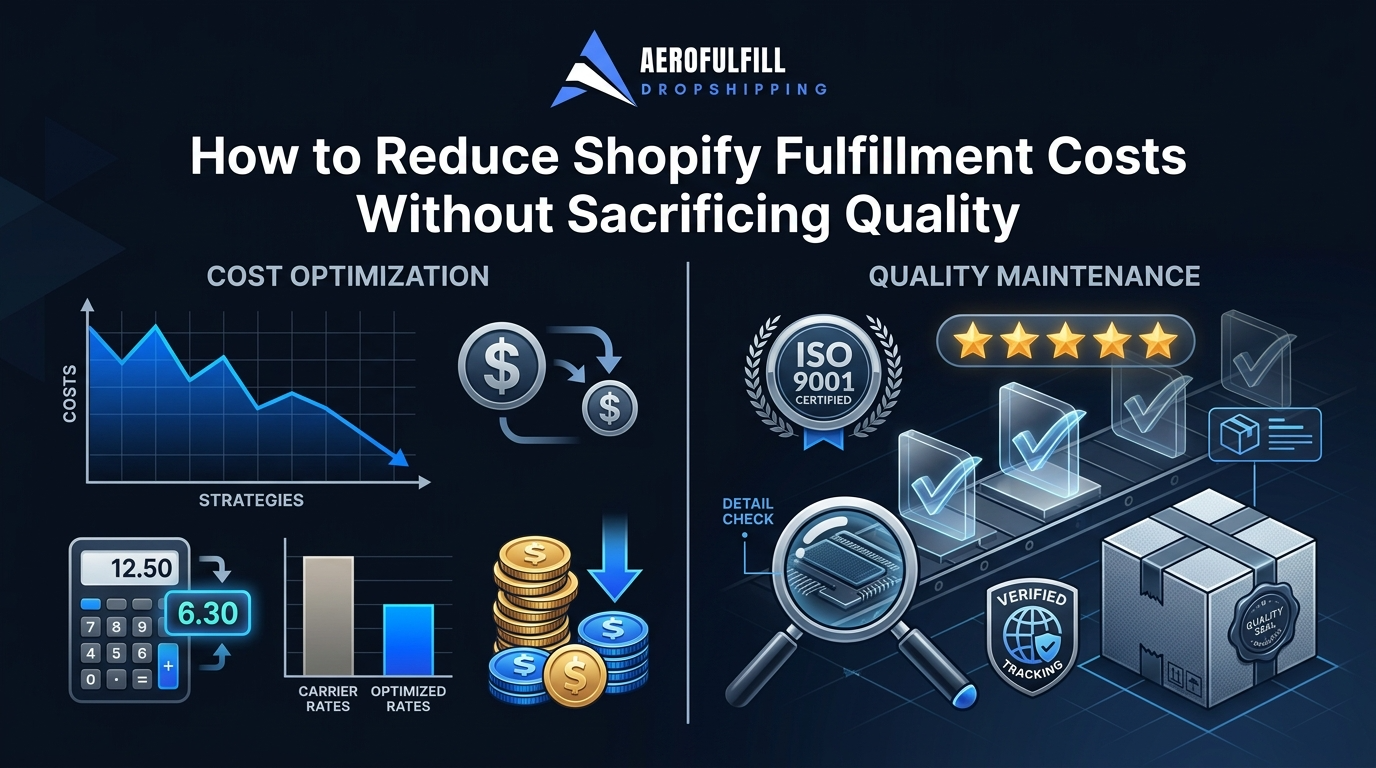
For growing Shopify brands, hitting a new revenue milestone is an incredible feeling—until you look at your profit and loss statement and realize how much of that top-line growth was eaten up by operational expenses. On average, fulfillment accounts for roughly 15% to 25% of a Shopify brand’s total revenue. Between picking, packing, shipping, and storage, the logistics of getting a product into your customer’s hands can severely compress your margins.
However, looking at fulfillment merely as a fixed cost of doing business is a mistake. By trimming your logistics expenses by just 3% to 5%, you can unlock a compounding effect that drastically improves your bottom-line profitability. The challenge, of course, is doing this without compromising the unboxing experience or extending delivery times. Here is a comprehensive guide on how to reduce your Shopify fulfillment costs while keeping your customers happy and your brand reputation pristine.
Audit Your Current Fulfillment Costs
You cannot optimize what you do not accurately measure. Many Shopify store owners look at the baseline shipping rate and assume that is their primary fulfillment expense. In reality, your true per-order cost is a complex combination of several moving parts. To find your actual baseline, you need to calculate the holistic cost of moving an item from the manufacturer to the end consumer.
This means adding up your pick and pack fees, the exact cost of packaging materials (from the corrugated boxes to the branded tape and inserts), warehouse storage fees, postage, and the often-ignored cost of processing returns. Once you break down your fulfillment expenses line by line, you will likely spot immediate inefficiencies. For instance, you might realize you are paying exorbitant fees for long-term storage of slow-moving SKUs, or that your pick-and-pack costs are unnecessarily high because of a complex kitting process. Establishing this baseline is the critical first step before you start pulling levers to reduce costs.
Negotiate Volume-Based 3PL Pricing
If you are outsourcing to a third-party logistics (3PL) provider, you should never treat their initial rate card as gospel. 3PL pricing is highly dynamic and heavily dependent on volume. As your Shopify store scales and your order volume increases, you gain significant leverage to negotiate better terms.
Start by understanding tier pricing. Most fulfillment centers operate on brackets—the more orders you process per month, the lower your per-order pick and pack fees become. Do not wait for your 3PL to automatically apply these discounts. Take the initiative to present your historical data alongside your realistic growth projections for the next quarter. If you can confidently commit to higher volume brackets based on upcoming product launches or peak seasonality, use that forecast to lock in lower rates immediately. If your current fulfillment partner is unwilling to budge, it might be time to shop those volume projections around to competitors.
Optimize Packaging Dimensions and Weight
One of the fastest ways to bleed money in ecommerce is by shipping air. Major carriers like UPS, FedEx, and USPS utilize a pricing model called dimensional (DIM) weight. This means they charge you based on the amount of space a package takes up in their cargo holds, not just its actual physical weight. If you are shipping a lightweight t-shirt in a massive box, you are paying a hefty premium for empty space.
To combat this, conduct a thorough audit of your packaging strategy. Switch to poly mailers or custom-fitted rigid mailers for apparel and non-fragile items. For larger goods, work with your packaging supplier to design custom boxes that perfectly hug your product’s dimensions, minimizing the need for heavy void fill like bubble wrap or crinkle paper. Downsizing your packaging by just a few inches can drop your shipments into a lower DIM weight pricing tier, saving you dollars on every single order dispatched.
Use Shipping Zone Optimization
Shipping zones dictate the distance a package must travel from your fulfillment center to your customer’s doorstep. The further the distance (the higher the zone), the more expensive the shipping cost and the longer the transit time. If all of your inventory is sitting in a warehouse in California, but your primary customer demographic is clustered on the East Coast, your shipping costs will be artificially inflated.
By analyzing your historical Shopify order data, you can identify geographic heat maps of where your customers actually live. If you spot heavy concentrations in specific regions, consider utilizing a fulfillment network that allows you to distribute your inventory across multiple strategic warehouse locations. Shipping from a facility closer to your core customer clusters keeps the majority of your shipments in lower, cheaper shipping zones. This dual-threat strategy not only slashes your postage costs but also delights customers with faster delivery times.
Consolidate Sourcing and Fulfillment Under One Roof
The traditional ecommerce supply chain is deeply fragmented. A Shopify brand might use a sourcing agent to find a factory, a freight forwarder to move the goods across the ocean, and a separate 3PL to handle the final-mile delivery. Every time your product changes hands, a new middleman takes a margin.
By consolidating your product sourcing and order fulfillment under one unified partner, you can dramatically streamline your operations. Eliminating the handoffs between disparate agents, forwarders, and warehouses removes redundant fees and communication bottlenecks. When your manufacturing pipeline feeds directly into your fulfillment infrastructure, you can often save 10% to 20% on your total landed cost. Furthermore, this consolidation gives you total visibility over your supply chain, allowing for leaner inventory forecasting and fewer stockouts.
Reduce Returns Through Quality Control
Returns are a massive drain on profitability. Not only do you lose the original sale, but you also have to absorb the cost of return shipping, the labor required to process the returned item, and the potential write-off if the product is no longer in sellable condition. While some returns are inevitable in ecommerce, a large percentage caused by product defects can be entirely prevented.
Implementing rigorous inbound Quality Control (QC) inspections at the warehouse level—before items are ever placed on the storage racks—is your best defense. A strong fulfillment partner should inspect shipments directly from the manufacturer to catch manufacturing flaws, incorrect sizing, or damaged packaging. By preventing defective units from ever shipping to the end consumer, you eliminate the costly cycle of return logistics and protect your brand from negative customer reviews.
Automate Order Routing
Manual fulfillment processes are a breeding ground for expensive human errors. If your team is manually exporting spreadsheets and deciding which orders go to which warehouse, you are wasting valuable time and likely missing out on cost efficiencies.
Leverage the power of the Shopify App Store to automate your order routing. Modern fulfillment software and inventory management systems can seamlessly integrate with your store to act as a digital traffic controller. The moment a customer clicks “Buy,” the system can automatically analyze their address and route the order to the warehouse facility closest to them, ensuring the cheapest possible shipping rate. These systems can also dynamically select the most cost-effective shipping carrier based on the package weight and destination, removing the guesswork and guaranteeing you always get the best rate.
Reducing fulfillment costs does not mean resorting to cheap packaging or painfully slow shipping options. It is about working smarter, eliminating supply chain friction, and optimizing every stage of the logistics journey—from the moment a product leaves the factory to the second it arrives on a customer’s porch. By auditing your baseline costs, optimizing your packaging, and leveraging a consolidated sourcing and fulfillment strategy, you can reclaim those lost margins and fuel your brand’s next stage of growth.
Related Resources
Shopify Fulfillment · Solutionsproduct Sourcing · Solutionsscaling Operations
Need Help With Your Fulfillment or Sourcing?
Get a custom quote — free, no commitment, within 24 hours. Trusted by 5,000+ Shopify brands.