
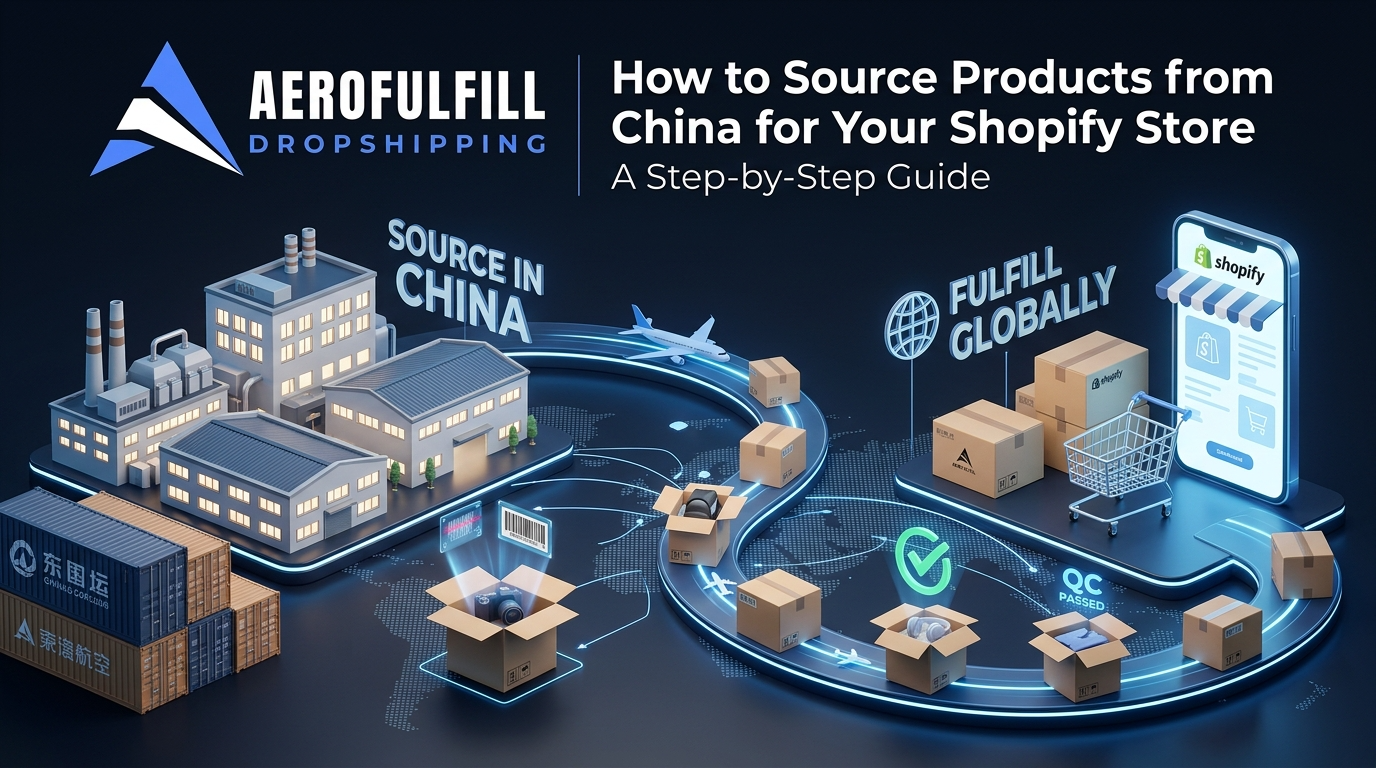
China manufactures roughly 28% of the world’s goods. Let that sink in for a moment. Nearly one in three physical products on the planet comes out of a Chinese factory — and yet most Shopify founders are still treating China sourcing like a side project, piecing things together through WhatsApp messages, Alibaba chat windows, and crossed fingers.
That’s a mistake, and a costly one.
The brands winning in e-commerce right now are not necessarily the ones with the best ads or the most viral products. They’re the ones who figured out how to build a factory-direct supply chain, protect their margins, and execute dropshipping orders fulfilment from China at a level that actually scales. The difference between a $30K/month store stuck on a plateau and a $500K/month brand is, more often than not, a fully functioning fulfillment and sourcing infrastructure — with a reliable China agent at the centre of it.
That’s exactly what this guide is about.
Whether you’re sourcing your first product or rethinking a supply chain that’s started showing cracks, this is a complete, opinionated, practical walkthrough of how to do it right. We’ll cover everything from writing your first product specification sheet to navigating quality control stages you didn’t know existed. And at the end, we’ll show you what enterprise-level Shopify orders fulfilment from China looks like when you stop duct-taping it together and start treating it as the infrastructure it actually is.
Let’s get into it.
Define Your Product Requirements
Before you contact a single factory, you need to know exactly what you’re buying. This sounds obvious, but it’s the step most new importers skip — and it costs them dearly in the form of wrong samples, wasted prototype fees, and supplier relationships that go nowhere because you couldn’t clearly articulate what you wanted.
Start with a specification sheet. This doesn’t need to be an engineering document, but it does need to cover the basics: dimensions, weight, materials, color options, any mechanical or functional requirements, and the performance standards the product must meet. If you’re sourcing a silicone phone case, that means durometer rating, thickness tolerances, and which devices it fits. If it’s a supplement, that means active ingredient concentrations, capsule type, and any certifications like GMP or FDA registration.
Your target cost should be established before you reach out to factories, not after. Work backwards from your retail price. If you’re selling at $39.99, and your marketing costs eat 35%, you need your landed cost — that’s product plus freight plus duties — to be somewhere under $10 to hit a healthy margin. That math tells you what factory price you can afford, which immediately filters out suppliers who aren’t a fit.
MOQ — minimum order quantity — is where a lot of new importers get scared. Chinese factories will quote MOQs ranging from 100 units to 10,000 depending on the product, the factory size, and how badly they want your business. Know your number before you start talking. If you can commit to 500 units, say so. If you can only do 100, say that too — there are factories that will work with you, and there are sourcing agents who can consolidate orders to make smaller quantities viable.
Finally, get a reference sample. Buy the closest existing product you can find on Amazon or in a local store, photograph every angle, measure every dimension, and attach that to your RFQ (Request for Quotation). It removes ambiguity and gives every factory the same visual brief to quote against.
Finding Factories — Alibaba, 1688, Canton Fair, and Sourcing Agents
There are four main channels for finding Chinese manufacturers, and each one has a very different risk and reward profile. Understanding which tool to use — and when — is one of the most valuable things you can learn as an importer.
Alibaba is the most familiar starting point for Western buyers. It’s in English, it has a verification system (Gold Supplier badges, Trade Assurance, audit reports), and the suppliers there are used to working with international buyers. The downside? Because Alibaba is so accessible to Western buyers, the prices are inflated accordingly. Many “factories” on Alibaba are actually trading companies — middlemen who source from the actual manufacturers and add a margin. Not always a dealbreaker, but it matters when you’re trying to cut costs at scale.
1688.com is Alibaba’s domestic Chinese sister platform. The prices are dramatically lower — sometimes 30–50% less for identical products — because you’re dealing with factories selling to the Chinese domestic market where there’s no English premium. The catch is that it’s entirely in Chinese, most suppliers don’t speak English, payment requires a Chinese bank account or a local agent, and there’s no Trade Assurance safety net. For most Western brands, 1688 is only accessible through a sourcing agent who can navigate it on your behalf. But when you get that access, the savings are real.
The Canton Fair — held twice annually in Guangzhou — is where the serious relationship-building happens. Walking the floor, meeting factory representatives face to face, touching actual samples, and having real conversations about capacity and capabilities is an entirely different experience from emailing a contact form. If your business is at a point where you’re spending $50,000+ a year on product, attending Canton Fair even once will likely pay for itself many times over.
Sourcing agents are, in my opinion, the highest-ROI channel for growing Shopify brands. A good sourcing agent is based in China, speaks Mandarin, has existing factory relationships across multiple product categories, and can access 1688 pricing while handling all the logistical complexity on your behalf — sample coordination, quality inspection, shipping documentation, and more. The fee (typically 5–10% of order value) is almost always more than offset by the lower factory prices, avoided mistakes, and time saved. Companies like Aerofulfill offer integrated sourcing alongside their Shopify fulfillment infrastructure, meaning your agent, your QC, your warehouse, and your carrier relationships all exist under one roof. For scaling brands, that kind of end-to-end visibility is genuinely invaluable.
How to Vet Chinese Factories
Finding a factory is easy. Finding a trustworthy one that can actually deliver what they promise is where most importers learn hard, expensive lessons. Here’s how to avoid being one of them.
The first thing you want to verify is the business license. Every legitimate Chinese manufacturer has a registered business license. Ask for it directly. Cross-reference the company name on the license with the name they’re operating under. If they hesitate or provide documentation that doesn’t match, walk away. Tools like Made-in-China and SGS verification services can help you cross-check this remotely.
Next, look at production capacity. Ask the factory: how many units per day can you produce of this product? What’s your current order book — are you at 60% capacity or 100%? A factory that’s completely maxed out may not be able to prioritize your order. Conversely, a factory that’s suspiciously empty might have quality or financial problems you’re not seeing.
ISO certification matters, but don’t be naive about it. An ISO 9001 certification tells you a factory has documented quality processes — not that the product will be perfect. Use it as a baseline filter, not a guarantee. For certain product categories — electronics (CE marking), children’s products (CPSC compliance), supplements (GMP certification), cosmetics (FDA/EU compliance) — the relevant certifications are non-negotiable. Verify them directly with the issuing body.
Reference checks are underused. Ask the factory for two or three international buyers you can contact. Most will provide them. Reach out, ask honest questions about on-time delivery, defect rates, and communication responsiveness. The answers will tell you more than any audit report.
For orders above $20,000, strongly consider an on-site factory audit. Third-party audit companies like Bureau Veritas, Intertek, or QIMA will send an inspector to the factory and produce a detailed report on everything from fire safety to production line conditions. It costs a few hundred dollars and could save you tens of thousands.
Requesting and Comparing Quotes
Once you’ve shortlisted two or four factories, it’s time to send your RFQ. A strong RFQ includes your product specification sheet, the reference sample photos, your target quantity (give a range — for example, 500–2,000 units), your required timeline, and any specific packaging or compliance requirements. Be specific. Vague RFQs generate vague quotes, and vague quotes make comparison impossible.
When quotes come back, the first thing to understand is the pricing term. FOB (Free On Board) means the factory price includes delivery to the port in China — from that point, you’re responsible for freight, insurance, and import duties. CIF (Cost, Insurance, Freight) means the factory or their agent has arranged shipping to your destination port — it sounds more convenient, but you lose visibility into the actual freight cost and often pay a premium for it. For most importers, FOB is preferable because it lets you control and optimize your own freight arrangements.
Comparing quotes meaningfully means aligning them to the same baseline. If Factory A quotes FOB Shenzhen and Factory B quotes EXW (Ex Works, meaning you collect from their door), they’re not comparable without adjusting for the inland freight difference. Build a simple spreadsheet: unit cost, tooling or mold fees (one-time), sample fees, packaging costs, and your estimated freight. The landed cost per unit is your true comparison figure.
Watch for hidden costs. Some factories quote a competitive unit price but add significant charges for custom packaging, labeling, or quality documentation. Always ask: what’s included in this price, and what will be invoiced separately?
Sample Production and Approval
Never, ever place a bulk order without going through a full sample process. I’ve seen brands skip this step to save two weeks, and then receive a 2,000-unit shipment that goes straight in the bin. The sample stage is where you validate everything — and it’s where you set the standard the factory has to match.
There are three types of samples you’ll encounter. A reference sample is an existing product the factory already makes — useful for assessing quality baseline and material feel but not specific to your product. A pre-production sample (sometimes called a “golden sample”) is made to your exact specification, before the production run starts. This is the critical one. It should match every dimension, material, color, and function you’ve specified. A production sample is pulled from the actual mass production run — it confirms the factory maintained the standard throughout manufacturing, not just during the sample stage.
Get the pre-production sample, evaluate it ruthlessly, and document every change needed with photos and written notes. Don’t give verbal approvals over WeChat. Written records protect you if there’s a dispute later. Expect at least two or three iterations for custom products — this is normal, not a red flag. A factory that gets your spec perfect on the first try is unusual; one that responds professionally to revision feedback and delivers an improved second sample is exactly what you want.
Your approval criteria should be pre-agreed in writing: dimensions within what tolerance? Color matching against what Pantone reference? Functional tests — does it work, does it hold, does it pass a drop test? When the golden sample is approved, both you and the factory sign off on it. That sample then lives at the factory and at your warehouse as the physical standard against which all production is measured.
Price Negotiation Strategies
Chinese factories respect confident, prepared buyers. Walking into a negotiation without leverage is the fastest way to pay more than you should. Here’s how to build that leverage.
Volume is your most powerful tool, even if you don’t have it yet. If you’re placing a 500-unit first order, tell the factory you expect to reorder 2,000 units within 90 days if quality and delivery are on point. Many factories will price you at the higher volume tier to earn the relationship. This isn’t a bluff — if your product validates, you should be planning those reorders anyway.
Payment terms are another lever. The standard is 30% deposit upfront and 70% before shipment. If you can offer a higher deposit — say 50% upfront — factories will often move on unit price because it reduces their working capital risk. Conversely, if you’re a high-volume repeat buyer, you can sometimes negotiate 60-day payment terms, which dramatically improves your cash flow.
MOQ negotiation works best when you offer something in return. If a factory’s standard MOQ is 1,000 units and you want 300, offer a slightly higher unit price in exchange for the lower quantity. You’re essentially paying for the setup costs that would otherwise have been amortized across a larger run. Many factories will accept this — they’d rather run your smaller order at a decent margin than have their machines idle.
Relationship matters enormously in Chinese business culture. The concept of guanxi — roughly translatable as relationship capital — is real. Regular communication, paying on time, providing honest feedback, visiting in person when you can, sending a gift during Chinese New Year — these things compound over time into a supplier relationship where you get priority scheduling, the best workers on your line, and flexibility when something goes wrong. The brands that treat Chinese factories as interchangeable vendors miss out on this entirely.
Quality Control — Pre-Production, Inline, and Pre-Shipment
Quality control is not a single event. It’s a process with multiple checkpoints, and each one serves a different purpose. Skipping any stage is a gamble that occasionally pays off and regularly costs you far more than the inspection fee you saved.
Pre-production QC is all about raw materials. Before manufacturing starts, your QC contact — either your sourcing agent or a third-party inspector — visits the factory to verify that the materials being used match what was specified. Wrong silicone grade, off-spec fabric, substandard electronics components — these problems are catastrophically cheaper to catch before they become 2,000 finished products.
Inline inspection happens during production, typically when 20–30% of the order is complete. The inspector examines finished units from the line, checks dimensions against the golden sample, tests function, and identifies whether any systematic defect is appearing. If there’s a problem with 20% of the order, you can still fix it. If you find the same problem at 100%, your timeline and your margin are both wrecked.
Pre-shipment inspection is the final check — usually when 100% of production is complete and at least 80% is packed. The inspector pulls a statistically representative sample based on AQL (Acceptable Quality Level) standards and tests against every specification in your list. This is the check that decides whether the shipment gets released.
What most importers miss is the inbound inspection at the fulfillment warehouse. Even after passing pre-shipment QC, shipments can be damaged in transit, mislabeled, or contain mix-ups in SKU quantities. A good fulfillment partner — like Aerofulfill — performs inbound inspection at their warehouse as a final safety net, verifying unit counts, barcode accuracy, and condition before a single item goes into pick-and-pack. That last check is what separates professional operations from ones that ship wrong items and generate avoidable returns.
Private Labeling and Packaging
Your product is only as compelling as the experience around it. Generic white-label packaging with a sticker slapped on it might work for your first test order, but it’s not building a brand — and it’s not generating the kind of unboxing content that drives organic social sharing and repeat purchase rates.
Logo placement should be decided early, because it affects the mold or tooling design for hard goods and the print plate for packaging. Work with your factory to determine where your logo can be applied, what method is being used (screen printing, embossing, debossing, UV printing, heat transfer), and what minimum size is required to maintain legibility. Get a rendered mockup approved before production starts.
Packaging design needs to serve two masters: your brand aesthetic and practical e-commerce functionality. Beautiful packaging that arrives crushed because it wasn’t designed for shipping is worse than plain packaging. Make sure your designer understands the shipping environment — drop tests, stack weight, humidity — and that the factory uses corrugated material with an appropriate burst strength rating for your product weight.
Barcode generation is non-negotiable for any brand selling on Shopify at scale. GS1 barcodes are the global standard. Generate your EAN or UPC codes through GS1’s official registry, embed them in your packaging artwork file, and verify that scanners read them correctly on the physical sample before approving the print run. Your fulfillment warehouse will need these codes to operate accurately.
Compliance labeling depends on your target market. Selling into the US means you need FCC, CPSC, or FDA compliance markings depending on product type. The EU has CE marking and REACH requirements. Australia has its own standards. Your sourcing agent or a compliance consultant can map the exact requirements for your product — but this is not optional, and getting it wrong can result in customs holds or market bans that shut down your entire operation.
Sourcing from China is one of the highest-leverage moves you can make as a Shopify brand founder. The cost advantages are real, the quality is achievable, and the infrastructure to support serious scale exists — you just need to know how to access it properly.
The brands that win aren’t necessarily the ones with the best product ideas. They’re the ones that built the best back-end: the factory relationships, the quality control processes, the fulfillment infrastructure that can absorb a viral moment without falling over.
If you’re ready to move beyond basic dropshipping orders fulfilment from China and build a real, scalable supply chain with a dedicated China agent and enterprise Shopify orders fulfilment infrastructure, Aerofulfill’s Wuxi-based operation is built exactly for that. With 5M+ Shopify orders fulfilled, a 0.04% chargeback rate, ISO-certified quality control, 5–7 day shipping SLAs to the US, UK, EU, CA, and AU, and a native Shopify API integration that takes 24 hours to go live — it’s the operational backbone that serious brands deserve.
👉 Request your free custom fulfillment quote at aerofulfill.com — no commitment, custom pricing within 24 hours, and a dedicated Logistics Architect to walk you through the entire setup.
Related Resources
Solutionsproduct Sourcing · Shopify Fulfillment · Industriesbeauty Skincare
Need Help With Your Fulfillment or Sourcing?
Get a custom quote — free, no commitment, within 24 hours. Trusted by 5,000+ Shopify brands.